Why 'BPA-Free' on a Plastic Container Isn't the Full Answer
Quick Answer: ‘BPA-free’ only addresses one specific chemical, but some replacement chemicals used in BPA-free plastics (like BPS) have raised similar concerns in early research. Glass or stainless steel for anything heated or acidic remains the more consistently lower-risk choice regardless of BPA-free labeling.
The BPA-free label solves the specific problem it was designed to address — it just isn’t the complete safety picture many people assume it is.
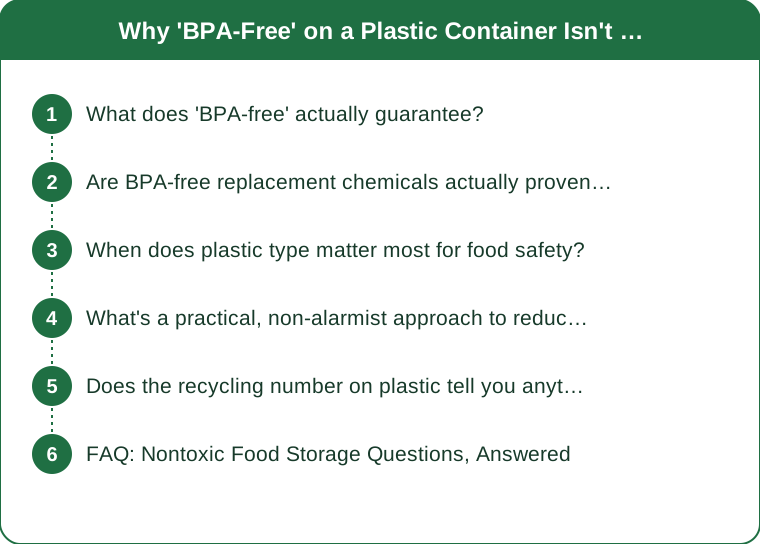
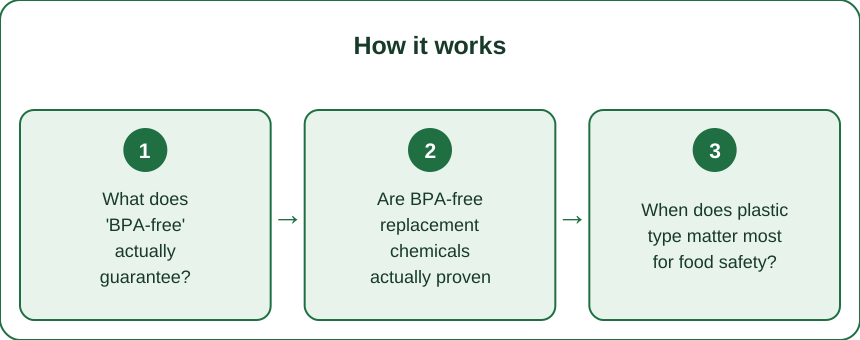
What does ‘BPA-free’ actually guarantee?
Only that the specific chemical BPA (bisphenol A) was not used in that plastic’s formulation — it says nothing about the replacement chemicals used instead, some of which (like BPS or BPF) have structurally similar properties and have raised comparable concerns in preliminary research.
Are BPA-free replacement chemicals actually proven safer?
Not conclusively — research on replacement bisphenols is less extensive than the decades of BPA research, and some early studies suggest similar hormone-disrupting mechanisms, meaning ‘BPA-free’ isn’t the same as ‘chemical-free’ or definitively lower-risk.
When does plastic type matter most for food safety?
Heat and acidity are the two biggest risk multipliers — microwaving in plastic, or storing acidic foods (tomato sauce, citrus) in plastic for extended periods, increases the chance of any plastic-associated chemicals migrating into food, regardless of BPA-free status.

What’s a practical, non-alarmist approach to reducing exposure?
Reserve glass or stainless steel for anything heated or acidic, and use plastic mainly for dry, room-temperature, short-term storage where the risk factors are lowest. This isn’t about eliminating plastic entirely, just matching material to actual risk level.
Does the recycling number on plastic tell you anything about safety?
Indirectly — numbers 3, 6, and 7 are generally considered higher concern categories (potential phthalates, styrene, or bisphenols), while 1, 2, 4, and 5 are generally lower concern for food contact, though ‘BPA-free’ status should still be checked separately.
FAQ: Nontoxic Food Storage Questions, Answered
Is it necessary to replace all plastic containers immediately?
Not necessary — a gradual swap, prioritizing containers used for hot or acidic food first, is a reasonable and less overwhelming approach.
Is glass genuinely risk-free for food storage?
Glass itself doesn’t leach chemicals the way plastic can, making it a consistently lower-risk choice, though lids are often still plastic and worth choosing carefully.
Are silicone containers a good middle ground?
Food-grade silicone is generally considered a lower-concern option for heat exposure specifically, though quality varies significantly between brands.
TL;DR:
- ‘BPA-free’ addresses one chemical, not the full range of possible plastic-related concerns
- Replacement chemicals in BPA-free plastic aren’t as thoroughly studied as BPA itself
- Heat and acidity are the two biggest risk multipliers regardless of BPA-free status
- Prioritize glass or stainless steel for anything hot or acidic, keep plastic for dry room-temperature storage
Start by swapping out whatever container you use most often for hot or acidic food — that single swap addresses the highest-risk use case first.
Keep Reading
This article is for general informational purposes only and is not medical advice. Always consult a qualified health professional for guidance specific to you.