Why Does Silicone Bakeware Hold the Smell of the Last Thing You Baked?
Quick Answer: Silicone has a loosely cross-linked structure that lets small oil-soluble molecules work their way in. Odour compounds from food are mostly oil-soluble, so they lodge inside the material rather than sitting on the surface — and standard dish soap, which is designed for surface grease, never reaches them.
You washed it three times. It still smells like garlic bread.
The smell is not on it. It is in it.
This is general information, not medical advice.
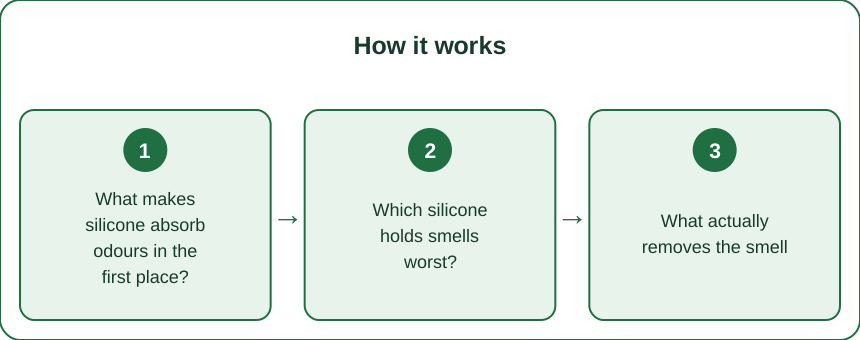
What makes silicone absorb odours in the first place?
Its structure. Silicone is a polymer with a relatively open, flexible network rather than a tight, sealed one like glass or glazed ceramic. At a molecular scale there is space between the chains.
Small, oil-soluble molecules — which is what most strong food odours are — can migrate into that space. Once inside, they are held by the same affinity that got them there: silicone is hydrophobic, so oily compounds are more comfortable in the material than in the water you are washing it with.
This explains the two things people find confusing:
Why soap does not work. Dish soap lifts grease from surfaces. It does not penetrate the polymer, so anything that has migrated in stays in.
Why the smell returns when heated. Heat increases molecular movement and drives absorbed compounds back out. A mould that smells fine cold will smell distinctly of last month’s curry the moment it hits 180 degrees — which is also, unhelpfully, the moment your next bake is in it.
Does this mean something is leaching into my food?
What you are smelling is previously absorbed food compounds coming back out, not the silicone itself breaking down. Food-grade silicone is generally considered stable at normal baking temperatures. The odour issue is a performance annoyance rather than the same question as material safety.
Which silicone holds smells worst?
Quality and additives matter more than brand.
Filled silicone — products bulked out with cheaper fillers — tends to be more porous and holds odour more readily. The common home test is to twist or pinch a piece firmly: if white streaks appear, there are likely fillers present. Pure silicone generally keeps its colour under twisting.
Thin, flexible items absorb faster than thick rigid ones because there is more surface area relative to volume and the material flexes more during use, which opens the structure.
Anything used with strong oils is the worst case. Garlic, curry spices, and anything cooked with a lot of fat are the classic offenders. Sugar-based baking barely causes it, which is why some people never encounter the problem at all.
Age matters. Repeated heat cycling gradually opens the structure further, so an item that resisted odour for a year may start holding it.
Is a smelly mould unsafe to keep using?
Not inherently — but a piece that has become sticky, discoloured, or misshapen has changed physically and is reasonable to retire. Sticky is the clearer signal: it usually indicates degradation rather than just absorbed odour.
What actually removes the smell
In order of how well they work.
1. Bake it empty. The most effective method by a clear margin. Put the clean item in the oven at around 180 to 200 degrees Celsius for 20 to 30 minutes. Heat drives the absorbed compounds out, and with nothing in the mould they leave rather than transferring. Ventilate the kitchen while you do it. Repeat once if needed.
2. Baking soda paste, then bake. Coat with a thick paste of bicarbonate of soda and water, leave for several hours, rinse, then do the empty bake. The paste helps with what is near the surface; the bake handles the rest.
3. A vinegar soak. Useful for lighter cases and for anything that has picked up a stale rather than oily smell. Less effective against garlic and spice.
4. Boiling water. Ten minutes in boiling water helps somewhat, and it is limited by temperature — 100 degrees moves far less than 190 does.
What does not work: more dish soap, dishwasher cycles alone, and leaving it outside. The dishwasher in particular gives people false confidence, because it removes surface residue completely and changes the absorbed odour not at all.
How do I stop it happening again?
Dedicate pieces. Keep one set for savoury and one for sweet, and the problem largely disappears. It sounds fussy and it is considerably less effort than repeatedly deodorizing.
Myth vs Fact: silicone in the kitchen
Myth: The smell means the silicone is breaking down. Fact: Absorbed food odour and material degradation are different things. Degradation shows up as stickiness, warping, cracking, or a chalky surface — those are the signals to replace an item, not smell alone.
Myth: All silicone is the same. Fact: Food-grade and platinum-cured silicone differ from cheaper filled products in porosity and stability. The twist test is a crude but useful screen, and buying from suppliers who state the grade is more informative than price.
Myth: Silicone is a straightforward upgrade over every plastic. Fact: It is generally more heat-stable than most plastics, which is a genuine advantage for anything that goes in an oven. It is also more absorbent than glass or stainless steel, which are the actual gold standards for storage. Silicone is a good answer to specific problems, not a universal one.
Myth: Odour transfer to the next bake is imaginary. Fact: People notice it because it is real — heating drives compounds out, and they have somewhere to go. Whether it is strong enough to matter depends on the item and what it absorbed.
Myth: Freezing it removes the smell. Fact: Cold slows molecular movement, so odour goes quiet in the freezer and returns on warming. It is a pause, not a fix.
FAQ: Silicone Bakeware Questions, Answered
Can I put silicone in the dishwasher?
Yes, and it will clean the surface well. Just do not expect it to address absorbed odour — those are different problems with different solutions.
What temperature is silicone actually safe to?
Most food-grade bakeware is rated to somewhere around 220 to 260 degrees Celsius, and the manufacturer’s stated limit is the one to follow. Direct flame, broilers, and stovetop contact are outside what it is designed for.
Is silicone better than parchment for the environment?
Over a long enough life, a reusable mat replaces a great many sheets of parchment, so the arithmetic favours it — provided you actually keep it for years. A mat replaced annually is a worse trade.
Should I be worried about older silicone items?
Inspect rather than worry. Sticky, discoloured, warped, or cracked pieces are worth replacing. Items that still look and feel like they did when new are generally fine to keep using.
Why does my silicone spatula smell but my baking mat does not?
Use pattern. Spatulas go into hot oily pans and sit in sauces; mats mostly see dry heat and sugar. The exposure explains more than the item does.
TL;DR:
- Silicone has an open polymer structure that oil-soluble odour molecules migrate into.
- Dish soap works on surfaces, so it never reaches what is absorbed.
- Bake it empty at 180 to 200 degrees for 20 to 30 minutes — that is the fix that works.
- Dedicate separate pieces to savoury and sweet and the problem mostly stops.
- Smell is not degradation; stickiness, warping, and cracking are the signals to replace.
The reason this feels so stubborn is that everyone treats it as a cleaning problem. It is a heat problem, and the oven you already own is the tool.
This is general information, not medical advice.
Keep Reading
This article is for general informational purposes only and is not medical advice. Always consult a qualified health professional for guidance specific to you.