Why Preheating an Empty Nonstick Pan Destroys It Faster Than Anything Else
Quick Answer: Food and oil in a pan hold the surface near the boiling point of water while they cook - an empty pan has nothing absorbing the heat, so the surface climbs extremely quickly. On a strong burner an empty nonstick pan can pass 500F within a couple of minutes and keep going. That is the range where PTFE coatings begin to break down and release fumes, and where the damage becomes permanent. Add the fat before the heat, use medium rather than high, and never walk away from an empty pan on a lit burner.
The habit came from cast iron and from restaurant kitchens, where heating the pan first is correct.
On a nonstick pan it is the single fastest way to ruin one, and it happens well before anything looks wrong.

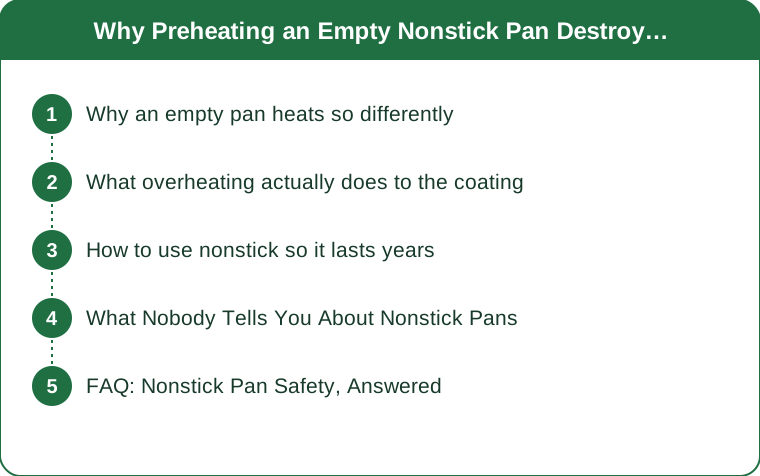
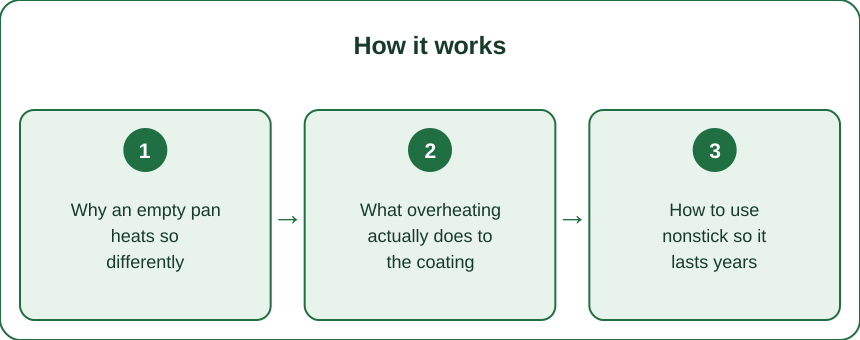
Why an empty pan heats so differently
Food and oil act as a heat sink. Water in food boils at 212F and holds the pan surface near that temperature while it evaporates, which is a natural ceiling on how hot the cooking surface gets.
An empty pan has no ceiling. All the energy from the burner goes into the metal and the coating, and the temperature climbs continuously for as long as the heat is on.
Thin pans climb fastest. Lightweight aluminium nonstick pans - the most common kind - have very little thermal mass, which is exactly what makes them responsive and exactly what makes them dangerous when empty.
PTFE coatings begin to degrade meaningfully above roughly 500F, with more significant breakdown and fume release as the temperature continues upward. Normal cooking with food rarely approaches this; an empty pan on high reaches it easily.
And the damage is invisible at first. The coating does not look different after its first overheat, but its release properties have already begun to decline - which is why people report pans that stop working after a few months without any obvious event.
What overheating actually does to the coating
Degradation is cumulative rather than a single failure. Each excursion past the safe range breaks down a little more of the polymer, and the pan gradually becomes stickier long before any flaking is visible.
Thermal cycling causes the coating and the metal to expand at different rates, which produces micro-cracking at the bond between them. This is the mechanism behind flaking, and it accelerates sharply with extreme heat.
Fume release at high temperatures is a genuine concern for pet birds, whose respiratory systems are exceptionally sensitive. This is the well-documented risk and it is a good enough reason on its own to keep pans below the range.
Once the surface has degraded, no treatment restores it. Seasoning a nonstick pan does not work the way it does on cast iron; the release property is a physical property of an intact coating.
A pan that has started flaking has reached the end of its life. Ingested flakes are generally considered inert and pass through, but a flaking pan no longer has an intact surface, which means the food is contacting bare metal anyway.

How to use nonstick so it lasts years
Add oil or butter to the cold pan, then turn on the heat. This single change removes the empty-pan problem entirely and costs nothing.
Use medium heat as the default and never high. Nonstick exists to cook things that stick - eggs, fish, pancakes - none of which want high heat. Searing steak belongs in stainless or cast iron.
Do not use it for broiling, oven work above the stated limit, or on induction at boost. Induction in particular heats a thin pan extraordinarily quickly.
Let it cool before washing. Running cold water into a hot pan thermally shocks the coating-to-metal bond and is a leading cause of premature flaking.
Skip aerosol cooking sprays. The propellants and additives leave a polymerised residue that builds up, cannot be removed, and makes the pan behave as though the coating has failed when it has not.
Store with a cloth or pan protector between stacked pans. Nested pans grinding against each other in a cupboard causes more coating damage than most cooking does.
And replace it when it stops releasing. A nonstick pan is a consumable with a life of roughly three to five years in regular use, and treating it as permanent equipment is how people end up cooking on a degraded surface.
What Nobody Tells You About Nonstick Pans
Most modern coatings are PFOA-free, and have been for years, because PFOA was a processing aid rather than part of the finished coating and its use was phased out. The concern people carry from older reporting largely refers to manufacturing rather than to the pan in your cupboard.
Ceramic nonstick is not automatically longer-lived. It typically has better heat tolerance but loses its release properties faster, often within a year or two of regular use.
The oil you use affects the coating indirectly. Oils past their smoke point polymerise into a sticky varnish that looks and behaves like coating failure. Cleaning that off with a baking soda paste often restores a pan people were about to throw away.
The dishwasher shortens nonstick life considerably, through both detergent harshness and sustained heat, even where the manufacturer says it is safe.
Metal utensils are less catastrophic than the folklore suggests but still net negative - a wooden or silicone utensil costs nothing and removes the variable.
And a good stainless pan plus one nonstick pan covers almost everything. Using nonstick for the two or three jobs it excels at, rather than for all cooking, is what makes it last.
FAQ: Nonstick Pan Safety, Answered
Is it dangerous if I have overheated a pan once?
A single overheat mainly costs coating life. Ventilate the kitchen, and keep pet birds well away from the kitchen generally, since they are the genuinely sensitive case.
How hot is medium heat, actually?
On most home burners, medium keeps a pan somewhere around 300 to 375F with food in it, which is ample for eggs, fish and pancakes.
Can I fix a sticky nonstick pan?
If the stickiness is polymerised oil residue, a baking soda paste and a soft cloth often restores it. If the coating itself has degraded, no.
What should I use for searing instead?
Stainless steel or cast iron, both of which are designed for the temperatures searing needs and neither of which has a coating to lose.
How do I know when to replace it?
When eggs stick to a clean pan with oil in it, or when you can see flaking or bare metal. Three to five years is typical for regular use.
TL;DR:
- Food and oil hold a pan near the boiling point of water; an empty pan has no ceiling and climbs past the coating’s safe range within minutes.
- Add the fat first, then turn on the heat - the single most valuable change you can make.
- Use medium as the default; nonstick exists for eggs, fish and pancakes, not for searing.
- Let the pan cool before washing, skip aerosol sprays, and protect pans in the cupboard from each other.
- A sticky pan is often polymerised oil rather than a dead coating, and baking soda paste frequently rescues it.
Nonstick pans are consumables with a three to five year working life. Replace them when they stop releasing rather than cooking on a degraded surface.
Keep Reading
This article is for general informational purposes only and is not medical advice. Always consult a qualified health professional for guidance specific to you.