How to Tell When a Nonstick Pan Should Be Retired — Four Checks
Quick Answer: Replace a nonstick pan when the coating is visibly flaking or peeling, when the base has warped enough to rock on a flat surface, or when food sticks despite proper heat and oil. Light surface scratches without flaking are a performance issue rather than a safety one. Most modern nonstick pans last three to five years with everyday use.
The pan is scratched and you have been told to throw it out. It is also the pan that works.
Four checks, and they give different answers for different problems.

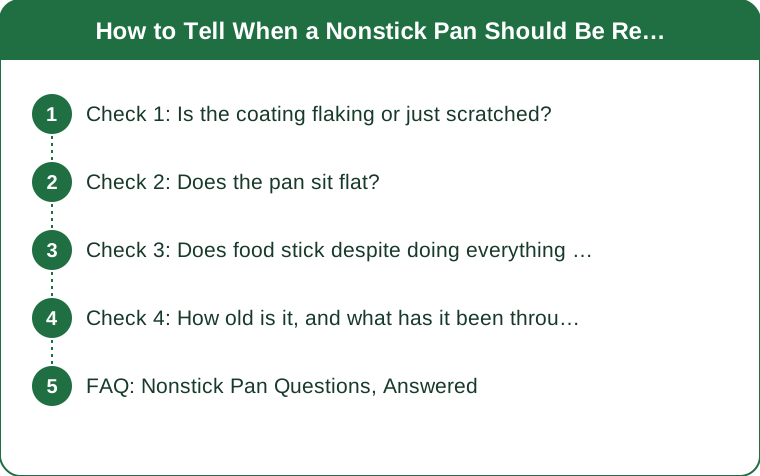
Check 1: Is the coating flaking or just scratched?
This is the distinction that decides everything.
Fine surface scratches are cosmetic in the short term. A utensil mark that has not lifted the coating leaves the barrier intact, though it will become a starting point for wear over time.
Flaking or peeling means the coating has lost adhesion. Visible chips, lifted edges, or flakes appearing in food mean the coating is coming off in pieces and the pan has reached the end of its life.
Look at it in raking light. Hold the pan so light hits the surface at a low angle. Lifted edges and pitting are far more visible this way than under direct overhead light.
Bare metal showing through is unambiguous. Once you can see the base metal, the coating has failed locally and the surrounding area will continue to lift.
Modern PTFE coatings are considered inert if ingested in small amounts, so an accidental flake is not an emergency. The reason to replace a flaking pan is that it will keep flaking and it no longer performs — this is a practical judgment more than an alarming one.
Check 2: Does the pan sit flat?
Warping is the failure people notice least and it wrecks cooking.
Put it on a flat counter and push one edge. If it rocks or spins, the base has warped.
A warped pan has uneven contact with the burner, which creates hot spots at the contact points and cool zones elsewhere. Oil pools at the low point and food cooks at three different rates.
Thermal shock is the usual cause. Running a hot pan under cold water, or putting a hot pan on a wet surface, causes rapid uneven contraction. Thin aluminum pans warp most easily.
Warping is not repairable on a nonstick pan. Even if the base could be flattened, the coating would not survive it.
And induction hobs are less tolerant of a warped base than gas, since contact area determines heating directly. On induction, a rocking pan is effectively unusable.

Check 3: Does food stick despite doing everything right?
Performance loss is the most common actual reason to replace.
Test properly before you conclude anything. Medium heat, a thin film of oil, and an egg. Preheat for about two minutes. If the egg sticks under those conditions, the coating has degraded.
High heat is the most common cause of premature loss. PTFE coatings degrade above roughly 500°F, and an empty pan on high heat can exceed that within a couple of minutes. Most ‘this pan died in a year’ cases are heat cases.
Residue buildup mimics coating failure. A thin polymerized layer of old oil creates a sticky film that behaves like a worn coating. Try a gentle scrub with baking soda paste first — sometimes the pan is fine.
Cooking spray is a genuine culprit. Aerosol sprays contain propellants and lecithin that leave a residue which builds up and is very difficult to remove. Oil from a bottle does not do this.
If cleaning restores performance, the pan is fine. If it does not, the coating is worn through and no treatment restores it.
Check 4: How old is it, and what has it been through?
Age alone is weak evidence, but history is not.
Three to five years is typical for everyday use. Daily use at the shorter end, occasional use at the longer.
Dishwasher use shortens life substantially. Detergents are abrasive and alkaline, and the heat cycle stresses the coating. A dishwasher-safe label means it will survive, not that it is unaffected.
Metal utensils accelerate wear even when they do not visibly scratch. Silicone, wood, or nylon costs nothing and roughly doubles usable life.
Stacking pans is an underrated killer. Stacked pans grind against each other in the cupboard, which produces exactly the kind of surface damage that leads to flaking. A cloth or a pan protector between them solves it entirely.
And what to do with the retired pan: most municipalities accept it as scrap metal rather than in household recycling, and some cookware brands run take-back programs. It is not a pan to donate — passing on a failing nonstick just relocates the problem.
This is general information rather than professional safety guidance. If you are concerned about specific cookware materials, manufacturer guidance and your local food safety authority are the appropriate sources.
FAQ: Nonstick Pan Questions, Answered
Is a scratched nonstick pan dangerous to use?
Modern PTFE coatings are chemically inert and considered to pass through the body without being absorbed if a small flake is ingested. The genuine risk with nonstick is overheating an empty pan, which can release fumes at high temperatures — this is the reason to avoid high heat rather than the reason to fear scratches. A scratched pan is mainly a performance problem.
Do ceramic nonstick pans last longer?
Generally no — ceramic coatings typically lose their nonstick performance faster than PTFE, often within one to two years, though they tolerate higher temperatures. They are a reasonable choice for people who want to avoid PTFE specifically, with the trade-off being a shorter useful life.
Can I season a nonstick pan to restore it?
No. Seasoning works on cast iron and carbon steel by polymerizing oil into a bonded layer on porous metal. A nonstick coating is not porous, so oil does not bond to it — anything you build up sits on the surface as residue and eventually makes sticking worse. Once a nonstick coating is worn, it is worn.
TL;DR:
- Flaking or peeling means replace; light scratches without lifting are a performance issue, not a safety one.
- Check for warping on a flat counter — a rocking pan heats unevenly and cannot be fixed.
- Test with an egg on medium heat before concluding; residue buildup often mimics a dead coating.
- High heat, dishwashers, metal utensils, and stacking are what actually shorten a pan’s life. Run the raking-light check and the flat-counter check on your main pan tonight. Both take ten seconds and they answer the question far better than how old the pan is.
Keep Reading
This article is for general informational purposes only and is not medical advice. Always consult a qualified health professional for guidance specific to you.