The Scratches on Your Containers Matter More Than the BPA Label
Quick Answer: Surface damage is what drives migration from plastic containers. Scratched, cloudy, or heat-warped plastic sheds far more particles and additives than intact plastic, regardless of what the BPA label says. Retire containers by condition, not by chemistry claims.
You replaced everything with BPA-free years ago and felt done. The containers that came out of that swap are now four years old, scratched by silverware, and cycled through a hundred dishwasher runs. Condition is the variable nobody put on the label.
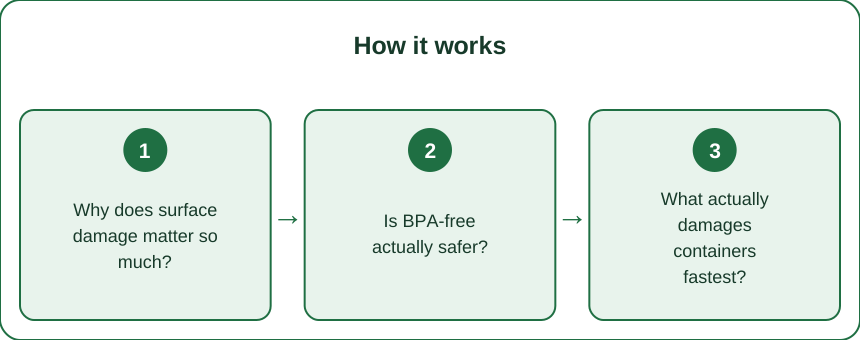
Why does surface damage matter so much?
Migration from plastic into food scales with surface area, temperature, and time. Scratches multiply effective surface area dramatically, and they also expose interior polymer that was never surface-treated.
Research on food-contact materials consistently finds higher migration from aged and abraded plastics than from new ones under identical conditions.
A scratch is not just cosmetic damage. It is a small canyon with far more exposed area than the flat surface around it, and it holds residue that no wash cycle fully clears.
Is BPA-free actually safer?
It removes one specific compound. The common replacements, BPS and BPF, are structurally similar and have their own emerging research concerns.
That does not make BPA-free meaningless; it makes it narrower than the marketing implies. It answers one question about one molecule and says nothing about additives, plasticizers, or particle shedding.
The practical takeaway is to stop treating the label as a verdict. Container condition, what you heat in it, and how long food sits in it all matter more than the specific bisphenol on the certificate.
What actually damages containers fastest?
In order:
- Dishwasher top-rack heat cycles, which soften polymer and accelerate crazing
- Metal utensils, which cut visible channels
- Microwaving oily foods, since fat carries heat higher than water and reaches temperatures the plastic was never rated for
- Tomato and citrus storage, whose acidity plus pigment stains and slightly degrades the surface
The cloudy white haze that develops on old containers is crazing, a network of microscopic cracks. Once a container is visibly hazy, it has structural surface damage throughout.
Myth vs Fact: Food storage plastics
Myth: Microwave-safe means safe to microwave anything. Fact: it means the container will not deform under standard conditions. Oily foods exceed those conditions routinely.
Myth: Staining means contamination. Fact: tomato staining is pigment, largely harmless in itself, but it is a useful signal that the surface has become porous.
Myth: All plastic sheds microplastics equally. Fact: polypropylene in good condition sheds far less than damaged or low-grade plastic. Condition dominates.
Myth: Glass is always the answer. Fact: glass is excellent for heating and storage, and the lids are almost always plastic with a silicone gasket. Those lids age like any plastic and are usually the part that needs replacing.
What is the practical rule?
Sort by condition, once, and then it stays easy.
- Retire anything scratched, hazy, warped, or stained from food use. They are fine for craft supplies and hardware.
- Keep plastic for cold storage and transport only
- Use glass or ceramic for anything heated, especially oily foods
- Hand wash remaining plastic, or bottom rack at most
- Replace lids and gaskets separately rather than whole sets, which is cheaper and targets the part that fails first
That is a fifteen-minute cabinet sort and it addresses the real variable rather than the labeled one.
This is general information, not medical advice.
FAQ: Food Container Questions, Answered
How often should I replace plastic containers?
By condition rather than schedule, but most daily-use containers show meaningful surface damage within two to three years.
Are silicone containers a good alternative?
Food-grade silicone is stable at high temperatures and does not craze the way rigid plastic does. Quality varies, so look for platinum-cured silicone.
What about takeout containers reused at home?
They are designed for single use and thin-walled, so they degrade very quickly under reheating. Reuse them cold or not at all.
TL;DR:
- Migration tracks surface damage, heat, and time, not just the chemistry label
- BPA-free answers one narrow question and says nothing about condition or additives
- Dishwasher heat, metal utensils, and oily microwaving cause the most damage
- Retire scratched or hazy containers, keep plastic cold, heat in glass
Open the container cabinet and pull out anything cloudy or scratched. That one sort does more for the actual concern than another round of label-shopping, and it takes about fifteen minutes.
Keep Reading
This article is for general informational purposes only and is not medical advice. Always consult a qualified health professional for guidance specific to you.