Plastic Cutting Boards and Microplastics: What the Research Says and What to Use Instead
Quick Answer: Chopping on plastic boards measurably releases microplastic particles — recent studies estimate tens of millions of particles per year for regular home use, with heavily scarred boards shedding most. The health impact of ingested microplastics is still being mapped, but the exposure itself is established and avoidable, because the alternatives are genuinely better tools: end-grain or edge-grain hardwood (maple, walnut, cherry) for daily work — naturally knife-friendly and, per classic food-safety research, no worse than plastic for bacteria when properly cleaned — plus a dedicated board for raw meat, which can be wood too, or rubber if you want the dishwasher. Skip bamboo glued with questionable adhesives and skip glass entirely; replace any plastic board with visible deep scarring first.
The cutting board is the rare kitchen swap where the precautionary choice and the better-performing choice are the same object. Nobody who moves from a scarred poly board to a proper maple one reports missing anything — the knife feels better, the board lasts decades, and the shavings stop going in the salad.

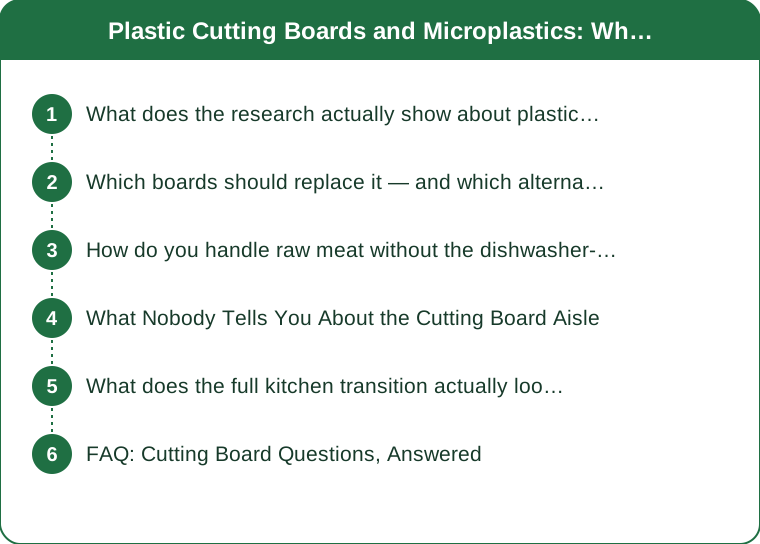
What does the research actually show about plastic boards?
That the shedding is real, quantifiable, and concentrated in exactly the boards most kitchens own.
The mechanics are unsurprising once stated: a knife edge striking polyethylene or polypropylene thousands of times carves the surface — every scar you can see is material that went somewhere, and where it went is your food and your sink. Recent peer-reviewed work put numbers on it: chopping produces visible and sub-visible polymer fragments with each session, and modeling of regular home use lands in the range of tens of millions of microplastic particles per person per year from boards alone — with per-session shedding rising as boards accumulate damage, because a rough scarred surface abrades far more easily than a fresh one.
What the science has not settled is the harm question. Microplastics are now found essentially everywhere researchers look in the human body, and early research raises flags around inflammation and cellular effects — but dose-response in humans is genuinely unresolved, and honest writing says so. The case for switching is therefore precautionary logic at its cleanest: an established, avoidable exposure with an uncertain harm profile, where avoidance costs nothing in performance.
Two scoping notes keep it fair. The board is one microplastic source among many (packaging and bottles matter too — the FAQ ranks them), so this is a reduction, not a purification. And the plastic board’s traditional selling point — dishwasher sanitizing for raw meat — is a real workflow benefit that any replacement plan has to answer, which the raw-meat section below does.
Which boards should replace it — and which alternatives are traps?
The podium is short, and two popular options do not make it.
Hardwood, end-grain or edge-grain, is the daily-driver answer. Closed-grain hardwoods — maple the classic, walnut and cherry close behind — are hard enough to resist deep scarring, soft enough to spare knife edges, and carry a food-safety record that surprised everyone: the well-known UC Davis research found wood performed as well as or better than plastic for bacterial safety, with bacteria drawn down into wood fibers where they die off rather than pooling in surface scars. End-grain (checkerboard-look butcher blocks) self-heals — the knife parts vertical fibers rather than severing them — and lasts decades; edge-grain costs less and serves a normal kitchen just as honorably.
Rubber boards are the professional’s quiet favorite — the dense synthetic-rubber boards of restaurant kitchens are knife-gentle, heavily scar-resistant (which is the microplastic point: shedding tracks scarring), and sanitize easily. For one dishwasher-tolerant meat board without plastic’s shed rate, rubber is the pick.
The traps: bamboo and glass. Bamboo markets as the eco-answer but is a grass laminated with adhesive — quality varies wildly, harder-than-hardwood surfaces chew knife edges, and the glue lines are a question mark the category rarely answers; a certified-formaldehyde-free board addresses part of it, but maple simply outclasses it. Glass (and stone) boards are knife destroyers that solve a problem nobody had — they belong under cheese at parties, never under a blade.
Retire first, regardless of replacement: any plastic board with deep visible scarring — it is the highest-shedding object in the drawer.
How do you handle raw meat without the dishwasher-plastic habit?
With a dedicated board and a two-minute protocol — the part of the switch people overthink.
Separation is the actual food-safety principle, not material: one board (or board side) for raw meat, poultry, and seafood, never crossing to produce and bread duty. Color-coding or a frank label handles the household coordination; the dedicated meat board being visually distinct is the whole system.
The wood-board meat protocol: scrape solids into the trash, wash promptly with hot soapy water both sides (washing one side warps boards), rinse hot, stand on edge to air-dry fully. For the extra step after poultry: a dilute vinegar wipe or a sanitizing rinse per your comfort, though hot soapy washing is the load-bearing step per food-safety guidance. What wood asks that plastic did not: no dishwasher (heat and soak cycles crack and warp it), no overnight soaking, and a monthly mineral-oil rub — five minutes while the kettle boils — to keep the surface sealed and split-free.
The rubber-board shortcut: if that maintenance list read as friction, assign raw meat to the rubber board and run it through the dishwasher with a clear conscience. Wood for everything else, rubber for meat, zero plastic in the rotation — the workflow keeps every convenience the poly board offered.
And the habit that outranks all boards: raw-meat juices travel by hands, knife handles, and faucet taps more than by board surfaces. The board swap upgrades one link; the wash-hands-between-tasks habit was always the strongest one.

What Nobody Tells You About the Cutting Board Aisle
“Wood” on the label is not a grade — the aisle’s real spread is construction. Thin printed-veneer boards and cheap acacia laminates sit next to solid maple at similar-looking prices; the tells for the real thing are weight (solid hardwood is heavy), visible continuous grain across the edge, thickness (an inch-plus resists warping), and a species name the listing is proud of. A solid edge-grain maple board from a restaurant-supply store frequently costs less than the decorative laminate at the home store — restaurant supply being the aisle’s best-kept secret in general.
The wellness market has also discovered the category, and the upsells deserve sorting: titanium and stainless boards are honest about shedding but hard on edges and loud; “antimicrobial-infused” plastic is still shedding plastic with a marketing layer; and paper-composite boards (the dense resin-paper type) are a legitimate middle path — dishwasher-safe, knife-reasonable, scar-resistant — for households that want exactly one board with zero maintenance, accepting resin binder in exchange for the convenience.
Board hygiene folklore needs one correction in each direction: the lemon-and-salt scrub is a pleasant deodorizer but not a sanitizer (hot soapy water remains the workhorse), and the fear that wood “holds bacteria” runs opposite to the research — it is scarred plastic where surface survival is the documented problem.
And mind the oil bottle: “mineral oil, food-grade” is the answer; cooking oils (olive, vegetable) go rancid in the wood and are the source of most smelly-board complaints. A $6 bottle lasts years — the entire ownership cost of a board that outlives the kitchen.
What does the full kitchen transition actually look like?
One purchase decision, one retirement decision, and a maintenance rhythm that takes minutes a month.
The two-board system covers most kitchens: a solid maple or walnut edge-grain daily board (roughly 12 by 18 inches — big enough that prep does not overflow, the most common sizing mistake) plus a distinct raw-meat board in rubber, composite, or a second contrasting wood. Households that batch-cook add a third small board for quick fruit-and-cheese jobs so the big board is not washed five times a day.
The retirement triage for existing plastic: deeply scarred boards leave now — and note they are polypropylene or polyethylene recyclables in many programs, though scarred food-contact plastic often lands in the bin; repurposing to non-food duty (paint tray, garage) is the honest second life. A lightly used plastic board can serve out time as the raw-meat board until the replacement arrives, since shedding tracks scarring — but the trajectory of every plastic board is toward scarred, which is why the category, not the copy, is what gets retired.
The rhythm thereafter: wash and edge-dry daily boards after use, oil monthly, and once or twice a year refresh the surface — a light sanding of the daily board’s most-used zone followed by oiling literally removes the scar history, a renewability no plastic board ever offered and the quiet reason wooden boards get handed down rather than thrown out.
Total transition cost runs modest against the years involved — and it is the rare non-toxic-kitchen swap with zero behavior change at dinnertime: same knife, same vegetables, same counter, minus the shavings.
FAQ: Cutting Board Questions, Answered
Where do cutting boards rank among kitchen microplastic sources?
Meaningful but not first. Plastic water bottles, plastic-packaged and heat-exposed foods (microwaving in plastic being the standout), and plastic tea bags all contribute heavily per the same body of research. The board earns its priority by being a one-time swap that removes a daily source permanently — most other sources require ongoing habit change, which is why the board is the efficient first move rather than the biggest single one.
Is an old wooden board with knife marks a bacteria problem?
Surface scarring on wood behaves differently than on plastic — the research found wood’s structure draws microbes inward where they perish, and normal washing plus drying handles routine use. A wooden board with deep gouges, standing cracks, or a persistent funk after washing is due for sanding or retirement on general principle, but the light knife-marking of years is patina, not hazard.
Are the flexible plastic cutting mats just as bad as boards?
Worse per session in the relevant way — thin flexible mats scar instantly and deeply relative to their thickness, and they are used precisely for the wet, knife-heavy jobs that maximize abrasion. They are also the easiest habit to replace: the wooden daily board plus the dedicated meat board covers everything the mat stack did.
Do I need to worry about wood species or finishes when buying?
Stick to closed-grain hardwoods — maple, walnut, cherry, beech — and skip open-grain species like oak for boards (deep pores hold moisture) and anything with a mystery varnish; a proper board arrives raw or mineral-oiled, never lacquered. Exotic-wood boards are a gift-shop phenomenon; the North American classics are the ones the food-safety record was built on.
TL;DR:
- Plastic boards shed measurably — tens of millions of particles a year in regular use, worst from scarred boards — and the harm question, while unresolved, buys nothing that better boards don’t provide anyway.
- The system: solid maple or walnut for daily prep (knife-friendly, decades-durable, research-backed on bacteria), plus a dedicated rubber or composite raw-meat board if you want the dishwasher.
- Skip bamboo laminates and glass; buy by weight, thickness, and visible solid grain — restaurant supply beats the decor aisle on price and honesty.
- Care is minutes: hot soapy wash both sides, dry on edge, food-grade mineral oil monthly, sand-and-refresh yearly. Retire the scarred plastic first.
Pull your most-used plastic board into the light and look at the scar field — that texture is the argument in physical form. Replace it this week, repurpose it to the garage, and let the maple start its multi-decade shift.
Keep Reading
This article is for general informational purposes only and is not medical advice. Always consult a qualified health professional for guidance specific to you.