Which Kitchen Swaps Actually Matter — and Which Are Marketing
Quick Answer: The swaps with the strongest evidence are avoiding heating food in plastic, replacing scratched nonstick cookware, ventilating while cooking at high heat, and not storing hot or acidic foods in plastic. Lower-priority swaps include replacing intact plastic storage used cold, changing all utensils, and most specialty cleaning products.
The non-toxic kitchen conversation is unusually noisy, and the noise runs in both directions.
One side says everything in your kitchen is dangerous. The other says none of it matters and you are being sold anxiety.
The actual picture has a clear hierarchy — a handful of changes with real evidence, a middle tier of reasonable-but-modest ones, and a bottom tier that mostly moves money around.

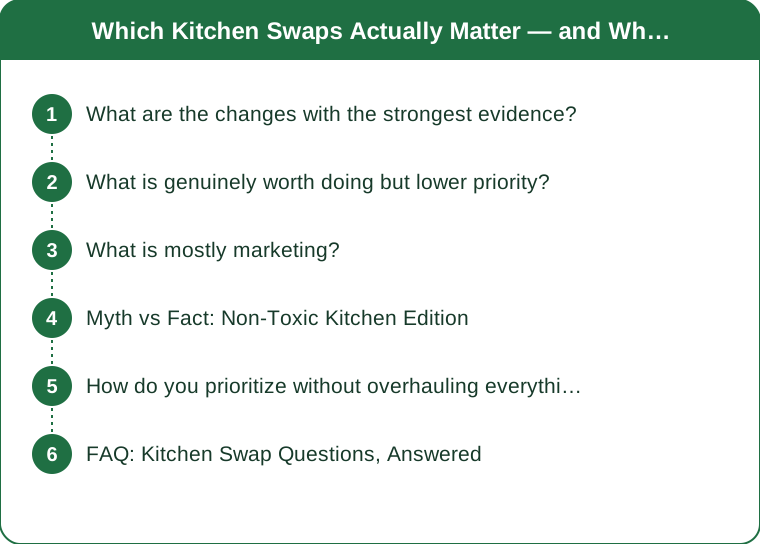
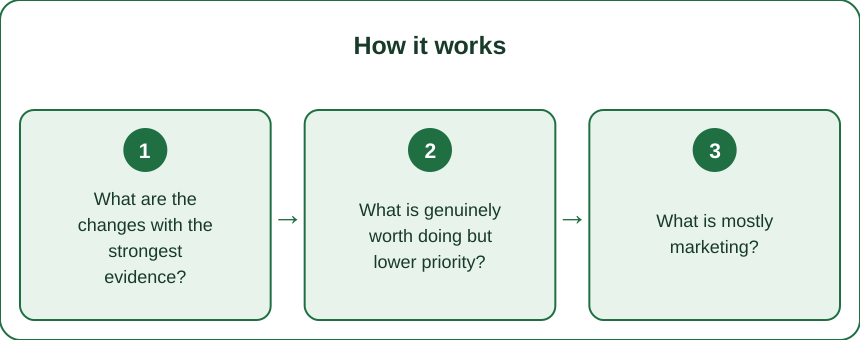
What are the changes with the strongest evidence?
Four, and they concentrate almost entirely around heat.
1. Stop heating food in plastic. This is the highest-value change on the list. Heat substantially increases chemical migration from plastic into food — this is well established. Microwaving in plastic containers, pouring hot liquid into plastic, and running plastic through a hot dishwasher cycle all accelerate it. Transfer to glass or ceramic before heating. This one change addresses most realistic plastic exposure in a kitchen.
2. Replace scratched or flaking nonstick cookware. Intact modern nonstick coatings are stable at normal cooking temperatures. Damaged coatings are a different situation — flakes end up in food and the underlying surface behaves unpredictably. Also avoid preheating an empty nonstick pan, which is how these surfaces reach temperatures they were never intended to hit.
3. Ventilate while cooking. Genuinely underrated. High-heat cooking produces ultrafine particles and combustion byproducts, and gas stoves additionally produce nitrogen dioxide. Running the range hood, or opening a window if you have no hood, is a free and meaningful improvement in indoor air quality.
4. Do not store hot or acidic foods in plastic. Tomato sauce, citrus, and vinegar-based foods increase migration, and doing it while hot compounds the effect. Glass for leftovers of anything acidic.
Notice the pattern: heat and acid are the two variables that matter most, and nearly every high-value swap addresses one of them.
What is genuinely worth doing but lower priority?
A middle tier that is reasonable without being urgent:
Replacing plastic storage gradually. Intact plastic containers used for cold storage are a much lower concern than heated plastic. Replacing them as they wear out — rather than throwing out a functional set — is a sensible pace. Glass containers with plastic lids capture most of the benefit, since the lid rarely contacts food.
Switching plastic utensils used in hot pans. A plastic spatula sitting in a hot skillet is being heated well beyond its intended range. Wood, silicone rated for high heat, or stainless are all straightforward replacements, and this one is cheap.
Cast iron or stainless for high-heat cooking. Not because nonstick is dangerous at normal temperatures, but because high-heat searing is where coatings are most stressed. Using the right pan for the job is good practice regardless.
Filtering drinking water. Depends entirely on your local supply. Worth checking your municipal water quality report before buying anything — some areas genuinely benefit and others are addressing a problem that does not exist.
Reducing canned food with linings, if you eat a lot of it. Most manufacturers have moved away from BPA specifically, though replacement linings vary. Modest priority; relevant mostly for heavy canned-food users.
What is mostly marketing?
Several categories that absorb attention out of proportion to their effect:
Replacing every plastic item in the kitchen at once. Expensive, wasteful, and mostly unnecessary. The exposure difference between heated plastic and cold-storage plastic is large, and treating them identically wastes effort that would be better spent on the four items in the first section.
Specialty “non-toxic” cleaning products. Most conventional dish soap and general cleaner are rinsed away and leave negligible residue. If you prefer them for scent or environmental reasons, that is fine — but they are not addressing a meaningful exposure route.
BPA-free as a complete answer. BPA was replaced with structurally similar compounds like BPS and BPF, which are less studied rather than demonstrably safer. “BPA-free” tells you what is absent, not what is present. The more useful heuristic remains avoiding heat with plastic regardless of labeling.
Ceramic-coated “non-toxic” nonstick. The coatings are generally fine and they also wear out considerably faster than traditional nonstick, often within a year or two. You end up replacing them frequently, which has its own cost. They are a reasonable choice, not a categorical upgrade.
Air purifiers as a substitute for ventilation. A purifier helps with particulates. It does not remove combustion gases the way exhausting to the outside does. Ventilation first, purifier second.
Wooden utensils as a safety measure. They are pleasant and durable. There is no meaningful safety gain over stainless or high-heat silicone, and they require more care to keep sanitary.

Myth vs Fact: Non-Toxic Kitchen Edition
Myth: Nonstick pans release toxic fumes during normal cooking. Fact: Modern nonstick coatings are stable at typical cooking temperatures. The concern involves overheating well beyond normal use — typically an empty pan preheated on high. Do not preheat empty, keep it below high heat, and ventilate.
Myth: All plastic leaches constantly. Fact: Migration is heavily dependent on heat, acidity, fat content, and contact time. Cold water in a plastic bottle for an hour is a very different situation from hot soup in a plastic container overnight.
Myth: Glass is always safer than plastic. Fact: Glass is inert and excellent for hot and acidic foods. It also breaks, and thermal shock from a hot dish into cold water is a genuine hazard. Safer chemically, requires more care physically.
Myth: If you can smell it, it is harmful. Fact: Smell indicates volatile compounds are present, not that they are harmful at that concentration. Many harmless things smell strongly and some hazardous gases have no odor at all.
Myth: Gas stoves are the biggest kitchen exposure. Fact: Gas combustion does produce nitrogen dioxide and it is worth ventilating for. But high-heat cooking of any kind — gas, electric, or induction — produces ultrafine particles. Ventilation matters regardless of your stove type, which is the more useful takeaway than the stove-type debate.
How do you prioritize without overhauling everything?
In this order, over a few months rather than a weekend:
This week, free:
- Stop microwaving in plastic. Transfer to glass or ceramic first.
- Run the range hood every time you cook at high heat, and open a window if you have no hood.
- Do not preheat empty nonstick pans.
This month, low cost:
- Replace any nonstick pan with a scratched or flaking surface.
- Swap plastic utensils that live in hot pans for wood, stainless, or high-heat silicone.
- Move acidic leftovers — tomato, citrus, vinegar — into glass.
Over the year, as things wear out:
- Replace plastic storage with glass gradually.
- Add a cast iron or stainless pan for high-heat work.
- Check your local water quality report and filter only if it warrants it.
Skip unless you have a specific reason:
- Replacing everything at once.
- Specialty cleaning products for safety reasons.
- Buying based on “BPA-free” labeling alone.
The organizing principle: heat and acid drive migration. Anything that reduces contact between food and plastic under heat or acid is worth doing; almost everything else is optional. That single rule handles the majority of decisions in this category without needing to evaluate individual products.
This is general information, not medical advice.
FAQ: Kitchen Swap Questions, Answered
Is my old nonstick pan dangerous if it is not scratched?
Intact modern nonstick used at normal cooking temperatures is generally considered fine. Pans manufactured before about 2013 may involve older chemistry, so if a pan is very old and you are unsure, replacing it is reasonable.
Are silicone bakeware and utensils safe?
Food-grade silicone is stable at typical cooking temperatures and is generally regarded as low concern. Look for products rated for the temperature you are using them at, and replace anything that has become sticky or degraded.
Does any of this matter compared to what I actually eat?
Honestly, dietary pattern, sleep, and activity have far larger effects on health than kitchen material choices do. These swaps are cheap and low-risk, which is why they are worth doing — not because they outrank the fundamentals.
TL;DR:
- Heat and acid drive chemical migration. Nearly every worthwhile swap addresses one of them.
- Top four: never heat food in plastic, replace scratched nonstick, ventilate, keep acidic food in glass.
- Middle tier: gradual plastic replacement, high-heat utensils, cast iron for searing.
- Mostly marketing: full plastic overhauls, specialty cleaners, and trusting “BPA-free” labels.
- Ventilation matters on every stove type, not just gas.
The three free changes in the first row of that list capture most of the available benefit. Doing those and stopping there is a perfectly defensible place to land, and considerably more useful than replacing a functional kitchen.
Keep Reading
This article is for general informational purposes only and is not medical advice. Always consult a qualified health professional for guidance specific to you.