Why Air Fryer Baskets Lose Their Coating and What That Means
Quick Answer: Air fryer baskets use the same PTFE-family nonstick coatings as pans, but they wear faster because of a harsher environment - higher sustained temperatures, forced hot air, metal-on-coating contact from shaking and tongs, and perforated surfaces with more edges to chip. Intact coating is stable at normal cooking temperatures; the concerns are overheating above roughly 500F and flaking into food. Replace the basket when the coating is flaking, not merely scratched.
Scratched is cosmetic. Flaking is the line.
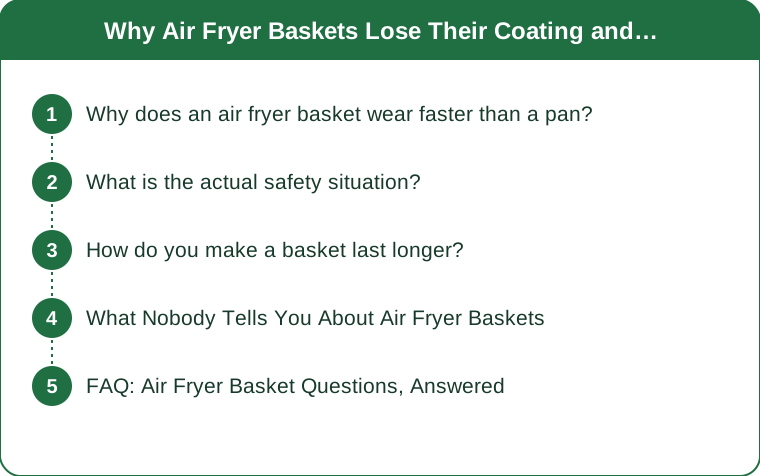
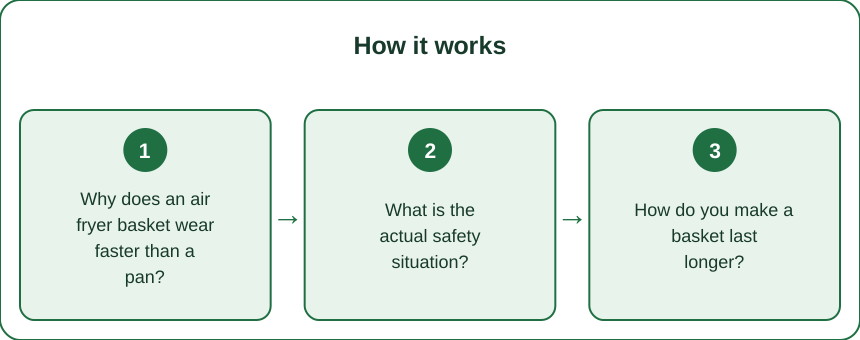
Why does an air fryer basket wear faster than a pan?
Because the conditions are harsher in four specific ways.
Higher sustained temperature. Air fryers routinely run at 380 to 400F for extended periods, and the heating element sits close to the basket. A frying pan on medium is usually cooler than that, and only briefly at the top of its range. PTFE coatings begin to degrade around 500F, and while normal air fryer settings stay below that, the basket spends far more time near the upper end of its comfortable range than a pan does.
Forced convection. The whole point of an air fryer is rapidly circulating hot air, which means continuous thermal cycling across the coating’s surface and dry heat rather than the buffering effect of oil or food moisture that a pan usually has.
Mechanical abuse. People shake the basket vigorously mid-cook - which is metal food and metal basket sliding against the coating repeatedly. Add tongs, forks, and the occasional metal spatula and the surface takes far more abrasion than a pan used with silicone tools.
Perforated geometry. The holes and mesh in most baskets create thousands of edges, and edges are where coating chips start. A flat pan surface has almost none. This is the structural reason baskets fail faster regardless of how careful you are.
Empty preheating compounds it. Running an air fryer empty to preheat means the coating reaches temperature with no food to absorb heat, which is the fastest way to reach the range where degradation begins. It is also the most common habit that shortens basket life.
What is the actual safety situation?
Worth being precise, because this topic attracts both overstatement and dismissiveness.
What the coating is. Most air fryer baskets use PTFE-based nonstick, the same family as the coating on nonstick pans. Some use ceramic-style sol-gel coatings, which are silica-based and a different chemistry.
PFOA is no longer the issue it was. PFOA was a processing aid historically used in making PTFE, and it has been phased out of cookware manufacturing - cookware sold today is essentially all PFOA-free. Concerns about PFOA specifically refer to a legacy issue and older cookware.
Intact PTFE is chemically stable and inert at normal cooking temperatures. It is not absorbed if a small flake is swallowed - it passes through. The concern is not acute toxicity from ingesting a flake.
The real concerns, in order:
- Overheating. PTFE begins to break down above roughly 500F and releases fumes that can cause temporary flu-like symptoms - polymer fume fever. It is well documented, and it is notably dangerous to pet birds, whose respiratory systems are extremely sensitive. If you keep birds, do not run PTFE cookware in the same room.
- Progressive coating loss. As coating flakes off, more of the metal substrate is exposed, food sticks more, and the appliance becomes harder to clean - which drives more aggressive scrubbing and more coating loss.
- What is underneath. Once the coating is gone, you are cooking on the base metal, usually aluminium, which is a different consideration.
The practical rule. Scratches are cosmetic and do not require replacement. Visible flaking, peeling, bubbling, or areas where the coating has come away entirely mean replace the basket. The difference is whether material is leaving the surface.
Many manufacturers sell replacement baskets, which is far cheaper than replacing the appliance and is worth checking before assuming the whole unit is done. This is general information, not medical advice.
How do you make a basket last longer?
Seven habits, roughly in order of effect.
1. Do not preheat empty for long. If your recipe needs a preheat, keep it short. Empty running puts the coating at temperature with nothing absorbing heat, which is the harshest condition it will ever see.
2. Use silicone or wood tools only. No metal tongs, no forks, no metal spatulas. This is the single biggest mechanical factor and it is entirely within your control.
3. Use liners for sticky or high-sugar foods. Perforated parchment liners or silicone baskets protect the coating from the worst residue. Two cautions: never run a paper liner without food weighing it down, since it can lift into the heating element and catch fire; and do not preheat with a loose liner in the basket.
4. Let it cool before washing. Thermal shock - a hot basket into cold water - stresses the bond between coating and substrate and causes lifting at the edges.
5. Hand wash with a soft sponge. Dishwashers are harder on nonstick than hand washing, even where the manufacturer permits it. Detergent is harsh and the wash is long and hot.
6. Never use abrasives. No steel wool, no scouring pads, no baking soda scrubbing. Soak instead - 20 minutes in warm soapy water removes almost anything, and it removes nothing of the coating.
7. Do not stack anything inside the basket for storage. Metal-on-coating contact in a cupboard causes scratches nobody notices happening.
Alternatives if you want to move away from coatings entirely: stainless steel baskets exist for some models and last indefinitely, at the cost of food sticking more; perforated stainless or ceramic inserts can sit inside an existing basket; and some models offer ceramic-coated baskets, which have their own trade-off - they typically wear faster than PTFE but do not contain fluoropolymers.
On lifespan: with heavy use and careless tools, a year is common. With silicone tools, no empty preheating, and hand washing, three to five years is realistic for the same basket.
What Nobody Tells You About Air Fryer Baskets
The perforations are why it fails, not the coating quality. Edges are where coating loss starts, and a perforated basket has thousands of them. This is a design constraint rather than a manufacturing shortcut.
Shaking the basket is the most damaging routine action. It is also the thing every recipe tells you to do. Use a silicone-tipped tool to stir instead where you can, or shake with the food more loosely packed.
Replacement baskets are usually available and cheap. Most people replace the whole appliance without checking, which is expensive and unnecessary. Search the model number plus replacement basket.
Bird owners should take this seriously. Polymer fume fever is mild and temporary in humans and can be fatal to pet birds. This applies to all PTFE cookware, not just air fryers, and it is the one part of the topic that is genuinely urgent.
Ceramic is not automatically better. Sol-gel ceramic coatings contain no fluoropolymers, which some people prefer, but they typically lose their nonstick property faster than PTFE. It is a trade-off, not an upgrade.
Cooking spray damages coatings. Aerosol sprays contain propellants and lecithin that polymerize into a sticky residue at high heat, which builds up and then gets scrubbed off aggressively. Brush oil on instead.
The metal underneath is usually aluminium. Once coating is gone in patches, you are cooking on aluminium with acidic foods potentially in contact. That is the practical argument for replacing a flaking basket rather than continuing.
FAQ: Air Fryer Basket Questions, Answered
Is a scratched air fryer basket safe to use?
Scratches alone are cosmetic. Flaking, peeling, or bubbling coating means replace it - the distinction is whether material is coming away.
What if I have already eaten some flakes?
PTFE is inert and passes through the digestive system without being absorbed. The concern is progressive coating loss and the exposed metal underneath, not an acute effect from a flake.
Can I use metal tongs carefully?
Not recommended. Metal on nonstick causes cumulative damage even with care, and the basket’s perforated edges are especially vulnerable. Silicone-tipped tools cost very little.
Are parchment liners safe in an air fryer?
Yes, if perforated, sized correctly, and weighed down by food. Never run one loose or during an empty preheat - it can lift into the element and ignite.
How long should a basket last?
With careless use, about a year. With silicone tools, no empty preheating, and hand washing, three to five years is realistic. Replacement baskets are usually available separately.
TL;DR:
- Air fryer baskets wear faster than pans because of sustained high heat, forced convection, metal contact from shaking, and thousands of perforation edges.
- Intact PTFE is stable at normal cooking temperatures; PFOA was phased out of cookware and is a legacy issue.
- Scratched is cosmetic. Flaking, peeling, or bubbling means replace the basket.
- Silicone tools, no empty preheating, cooling before washing, and no abrasives are the four habits that matter most.
- Overheating above roughly 500F produces fumes that are mild in humans and can be fatal to pet birds.
Check whether your model sells a replacement basket before replacing the whole appliance.
Keep Reading
This article is for general informational purposes only and is not medical advice. Always consult a qualified health professional for guidance specific to you.