Why Cooking Spray Wrecks Nonstick Pans Faster Than Heat Does
Quick Answer: Aerosol cooking sprays contain propellants and additives like lecithin that polymerise onto the nonstick surface at cooking temperatures, building an invisible sticky residue that does not wash off. Food then sticks to that residue rather than to the coating, and people conclude the pan has failed. Use oil from a bottle or a refillable pump mister instead, and remove existing buildup with a paste of baking soda and warm water plus a nonabrasive pad.
This is the most common way a nonstick pan dies prematurely, and almost nobody connects the two. The pan is usually fine underneath.

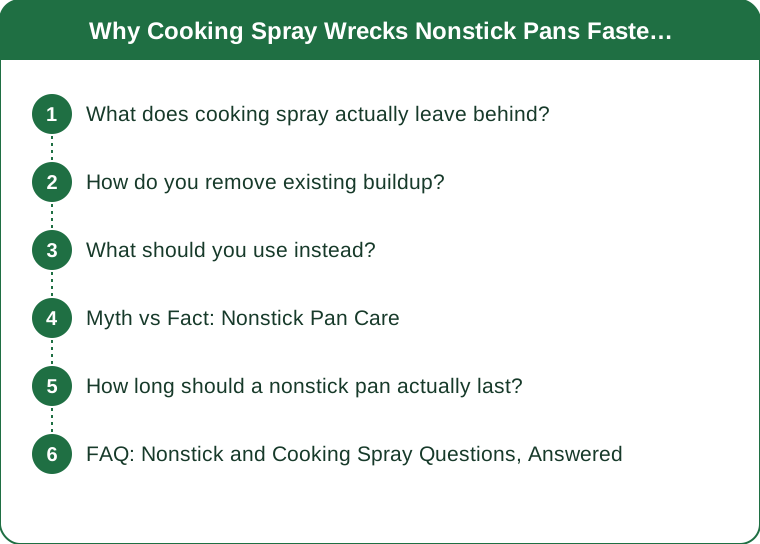
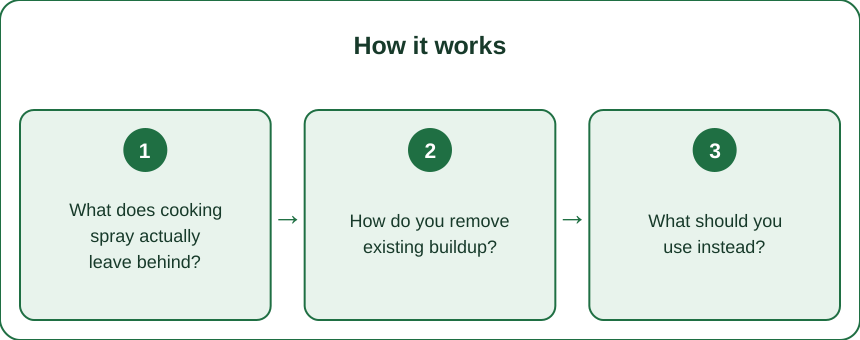
What does cooking spray actually leave behind?
A polymerised layer that is chemically different from cooking oil.
Aerosol sprays are not simply oil. They contain lecithin as an emulsifier, anti-foaming agents like dimethyl silicone, and a propellant. Lecithin in particular breaks down and polymerises at relatively low temperatures — below the smoke point of the oil itself.
When that happens on a nonstick surface, the residue bonds to the coating in a thin, uneven, slightly tacky film. It is nearly invisible, which is why people do not identify it. You can sometimes see it as a faint brownish sheen when you tilt the pan under a light.
Each use adds another layer. Over months, the buildup becomes thick enough that food adheres to it — and because the residue is not the coating, no amount of gentle care preserves performance.
The nonstick surface underneath is frequently undamaged. This is why a pan people were about to throw away often performs well again after the residue is removed.
How do you remove existing buildup?
A two-stage approach, gentle first.
Stage one: baking soda paste. Mix baking soda with a little warm water to a thick paste. Spread it over the cooking surface and let it sit for 15 to 20 minutes. Then work it gently with a soft nonabrasive pad or a nylon brush, in circles. Rinse thoroughly.
This lifts light to moderate buildup and is safe for any nonstick coating.
Stage two, if residue remains: simmer with vinegar. Add water with about half a cup of white vinegar to the pan, bring to a gentle simmer for 5 to 10 minutes, then cool, empty, and repeat the baking soda step.
What not to use: abrasive scouring pads, steel wool, oven cleaner, or the dishwasher. All of these damage the coating directly, converting a fixable problem into a genuinely ruined pan. Dishwasher detergent is particularly harsh and degrades nonstick coatings over repeated cycles.
After cleaning, dry fully and wipe with a very thin film of cooking oil. Test with an egg — if it releases cleanly, the coating was intact and you have recovered the pan.
What should you use instead?
Three options, all better than aerosol spray.
Oil from a bottle, applied with a paper towel or brush. You use far less than you expect, and applying with a towel spreads a genuinely thin even film rather than the puddle that pouring creates. Cheapest and simplest.
A refillable oil mister. Pump-action bottles you fill with your own oil, $10 to $20. Gives you the spray convenience without propellants or additives. Clean it periodically — oil residue clogs the nozzle and can go rancid inside the reservoir.
Butter or ghee for suitable dishes. No additives, though milk solids in butter brown at lower temperatures. Ghee handles higher heat cleanly.
One note about oil choice: for nonstick pans you should be cooking at moderate heat anyway, so smoke point is rarely the limiting factor. Avocado, refined olive, and neutral seed oils all work. Extra virgin olive oil is fine at the temperatures nonstick pans should be used at.
The amount matters more than the type. A teaspoon spread thin outperforms a tablespoon puddled in the centre.

Myth vs Fact: Nonstick Pan Care
Myth: Cooking spray is safer than oil because it is less fat. Fact: The calorie difference is trivial at the quantities used, and the additives are what cause the residue problem. A teaspoon of oil applied with a towel uses less than most people spray.
Myth: A scratched nonstick pan is dangerous and must be discarded. Fact: Modern PTFE coatings are inert and pass through the body unchanged if ingested in small flakes. A heavily scratched pan performs poorly and should be replaced for that reason, not out of acute toxicity concern. What genuinely matters is avoiding overheating an empty pan above about 500F, where the coating can begin to degrade and release fumes.
Myth: You can restore nonstick with a seasoning process. Fact: Seasoning works on cast iron and carbon steel, not on PTFE. Building up polymerised oil on a nonstick surface is exactly the problem described here, not a solution.
Myth: Higher heat cooks better in nonstick. Fact: Nonstick pans are designed for low to medium heat. High-heat searing belongs in stainless or cast iron, and using nonstick for it shortens the pan’s life considerably.
Myth: All nonstick coatings are the same. Fact: Ceramic coatings behave differently from PTFE — they tend to lose performance faster with heat exposure but contain no fluoropolymers. Both are damaged by spray residue.
How long should a nonstick pan actually last?
Three to five years with good care, one to two with spray and dishwasher use.
The realistic lifespan of a mid-price nonstick pan used several times a week is around three years. Premium pans with thicker multi-layer coatings can reach five or more. Anyone claiming a decade of daily use is either very gentle or not being honest about performance.
Signs it is genuinely finished rather than dirty: food sticks even after a proper baking soda clean, the coating is visibly flaking rather than scratched, or the surface has gone dull and rough across the whole cooking area.
Rotate your pans. Using a stainless or cast iron pan for anything high heat, acidic, or aggressive extends the nonstick pan’s life substantially, because the nonstick only handles the tasks it is genuinely good at — eggs, delicate fish, pancakes.
A practical habit: keep one nonstick pan for eggs and delicate work, hand wash it, never spray it, never use it above medium heat. That pan will outlive three general-purpose ones.
As soup and braising season starts in the coming weeks, the nonstick pan gets used less and heavy pots more — a good moment to do the baking soda reset and store it properly for the winter.
FAQ: Nonstick and Cooking Spray Questions, Answered
Does this apply to air fryer baskets too?
Yes, and more so. Air fryer baskets run hot with strong circulation, and spray residue builds up quickly in the mesh and corners where it is hard to clean. Toss food in oil in a bowl before it goes in the basket instead.
Are propellant-free sprays safe for nonstick?
Better, but check the ingredients. Many still contain lecithin or other emulsifiers, which are the main polymerising culprit. A pure oil in a pump mister with no additives is the reliable option.
Can I use cooking spray on stainless or cast iron?
It still leaves residue, but those surfaces tolerate scrubbing, so the buildup is straightforward to remove. On cast iron the residue can interfere with a good seasoning layer, so oil from a bottle remains the better choice.
TL;DR:
- Aerosol sprays contain lecithin and additives that polymerise into an invisible sticky film on nonstick coatings.
- Food sticks to that residue, not to a failed coating — the pan is usually recoverable.
- Remove buildup with a baking soda paste and a nonabrasive pad; never use scouring pads, oven cleaner, or the dishwasher.
- Switch to oil applied with a towel or a refillable pump mister, and keep nonstick to low and medium heat.
Try the baking soda treatment on the pan you were about to replace. A good proportion of pans people consider dead come back completely.
Keep Reading
This article is for general informational purposes only and is not medical advice. Always consult a qualified health professional for guidance specific to you.