Why Dishwasher Heat Ages Plastic Containers Faster Than the Microwave
Quick Answer: A microwave heats food for two minutes; a dishwasher holds plastic at high temperature in an alkaline detergent solution for one to two hours, repeatedly. That combination of sustained heat, high-pH detergent, and mechanical spray is what actually degrades the surface - creating the micro-scratches and cloudiness that matter far more than any single microwave cycle. The practical rule is top rack only, or better, hand wash the containers you plan to keep.
Which reframes the usual advice: the microwave is the appliance people fear and the dishwasher is the one doing the damage.
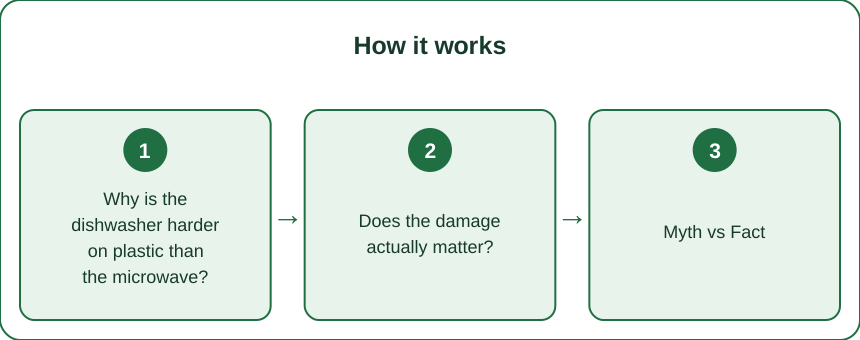
Why is the dishwasher harder on plastic than the microwave?
Because degradation depends on time at temperature, not peak temperature alone.
Duration is the main difference. A microwave cycle exposes a container to elevated temperature for perhaps two to three minutes. A dishwasher cycle can hold it at high temperature for well over an hour, and the heated drying phase is the hottest and longest part. Multiply by three cycles a week and the exposure difference is enormous.
Detergent chemistry is aggressive. Dishwasher detergents are strongly alkaline - far more so than hand washing-up liquid - because they need to break down fats without scrubbing. Alkaline solutions at high temperature attack polymer surfaces, which is exactly what produces the chalky, cloudy finish on old containers.
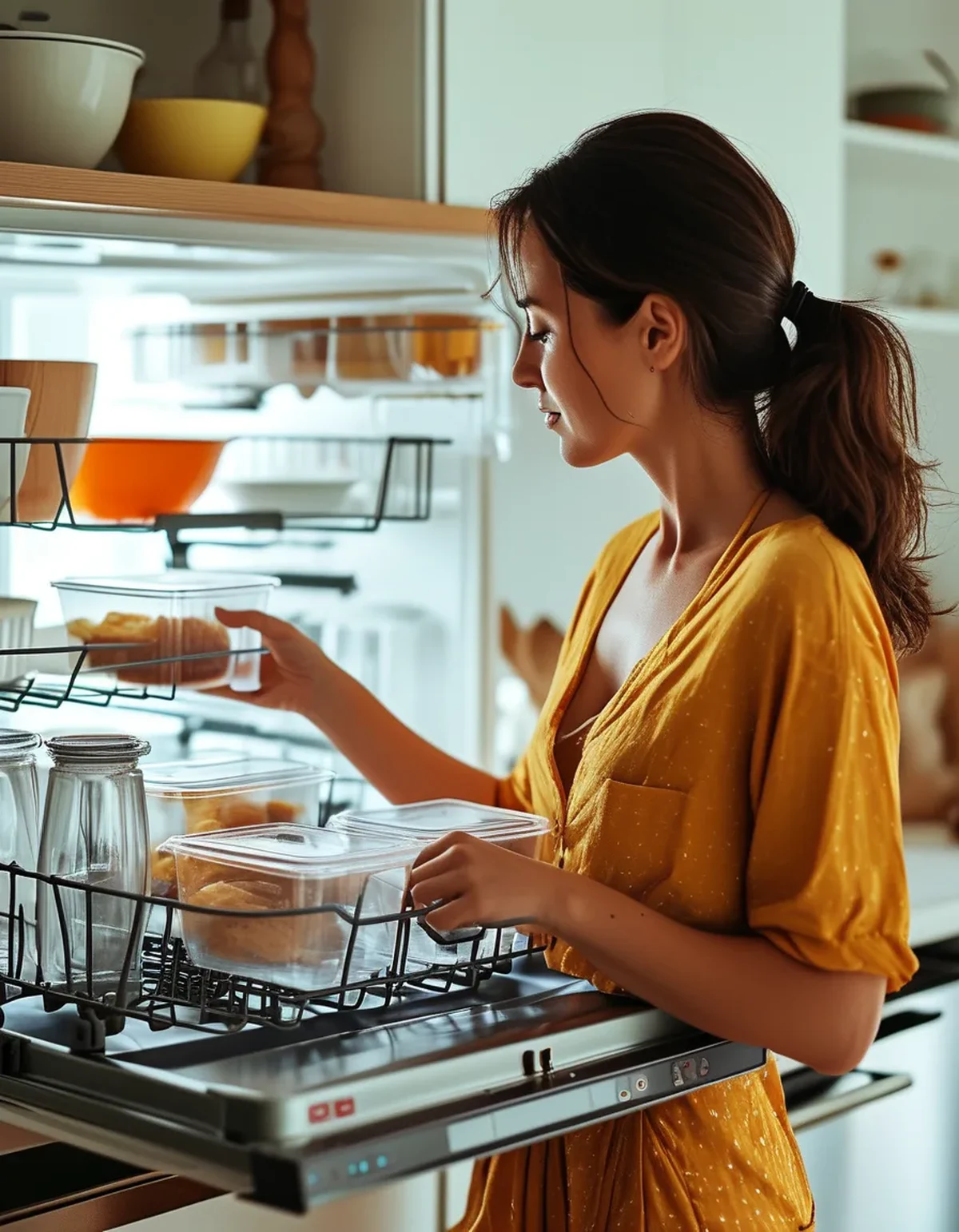
The bottom rack is worst. It sits closest to the heating element, and in many machines the temperature difference between racks is substantial. A container on the bottom rack can warp visibly in one cycle - and warping is only the visible end of a change that is happening invisibly on every cycle.
And high-pressure spray adds mechanical abrasion. Combined with the heat and the chemistry, it produces micro-scratches across the whole surface rather than in the few places a sponge touches. Scratches are the actual issue, because they hold residue, harbour bacteria, and expand under thermal stress.
Does the damage actually matter?
It matters for practical reasons that are easier to reason about than the scarier headlines.
Scratched plastic holds onto food and odour. Once the surface is no longer smooth, tomato sauce, curry, and garlic embed in the texture. The container that permanently smells of last month’s chilli is a mechanically degraded container, not a badly washed one.
Damaged surfaces release more particles. Research on food containers has consistently found that worn, scratched, and repeatedly heated plastics shed more microplastic particles into food than new, intact ones. The direction of the finding is well established even where the health significance is still being studied - which is a reasonable argument for replacing visibly worn containers rather than for panicking.
Warped lids stop sealing. This is the mundane failure that actually drives replacement. Once a lid has been through enough hot cycles to lose its shape, the container leaks in a bag and stops being useful.
And cloudiness is a signal, not just cosmetic. The chalky look is surface degradation - it means the polymer surface has been etched. A cloudy container is telling you it has had enough heat, which is useful information even though the container still technically works.
The reasonable position: this is not a crisis, and it is a good reason to change a routine that costs nothing to change.
Myth vs Fact: Plastic Containers
Myth: BPA-free means heat-safe. Fact: BPA-free describes one absent chemical, not thermal stability. A BPA-free container degrades under dishwasher heat exactly like any other, and often uses substitute compounds that are simply less studied.
Myth: dishwasher safe means no damage. Fact: it means the container will not melt or fail structurally. It is a survival claim, not a preservation claim - and in most cases it assumes the top rack.
Myth: the microwave is the dangerous appliance. Fact: brief microwave heating in a microwave-safe container is a much smaller cumulative exposure than years of dishwasher cycles. If you are going to change one habit, change the washing one.
Myth: glass has no downsides. Fact: glass is genuinely better for heat and scratching, but the lids are almost always plastic, and the lid is what touches hot food and goes through the dishwasher. Glass bodies with worn plastic lids are extremely common.
Myth: you should throw out all plastic containers immediately. Fact: intact, unscratched containers used for cold storage are a perfectly reasonable tool. The change worth making is how you wash them and what you heat in them, not a bin bag.
What should you actually do?
Six changes, none of which require replacing your kitchen.
1. Top rack only, always. This is the single biggest reduction in heat exposure available, and it costs nothing. If it does not fit on the top rack, hand wash it.
2. Turn off heated drying if your machine allows. The drying phase is the longest sustained heat exposure in the cycle. Air dry or open the door at the end - it also saves energy.
3. Hand wash anything you want to keep long term. Warm water and washing-up liquid is dramatically gentler than an alkaline dishwasher cycle. A soft sponge, never an abrasive pad.
4. Do not microwave in plastic if a bowl is available. Transfer to glass or ceramic. It takes ten seconds and removes the exposure entirely, which is easier than deciding which containers are safe enough.
5. Retire on visible signals. Cloudiness, scratches you can feel with a fingernail, warped lids, permanent staining, or persistent odour. Any one of those is a reasonable replace trigger.
6. Buy glass bodies where practical and treat the lids as consumables. Lids are the weak point and are often available as spares. A glass container with a replaced lid every couple of years is a genuinely long-lived system.
One seasonal note: as batch cooking picks up through autumn, container use roughly doubles in most households. Sorting the routine now, before soup season, is better timing than sorting it in November when everything is already in rotation.
FAQ: Container Care, Answered
Is the top rack actually cooler?
Yes, meaningfully so in most machines - it is further from the heating element and gets less direct exposure during the drying phase. It is the difference between warping and not warping for many containers.
What does cloudiness mean?
Surface etching from repeated alkaline detergent and heat exposure. It is not just cosmetic - it indicates the surface has degraded and is more likely to hold residue and shed particles.
Should I stop using plastic containers altogether?
Not necessarily. Intact containers used for cold storage are fine. The higher-exposure situations are heating, prolonged dishwasher cycles, and storing hot food - those are worth changing first.
Are glass containers completely plastic-free?
The body is, but almost all lids are plastic with a silicone seal, and the lid contacts hot food and goes through the wash. Treat lids as the part that needs care and replacement.
How often should I replace containers?
When they show scratching you can feel, cloudiness, warping, staining, or retained odour. There is no fixed timeline - condition is a better guide than age.
Is silicone a better option?
Silicone tolerates heat well and does not scratch the same way, though quality varies and cheap silicone can be blended with fillers. For lids and seals it is generally a good choice.
TL;DR:
- Time at temperature, not peak temperature, drives degradation - and a dishwasher cycle is 30 times longer than a microwave one.
- Dishwasher detergent is strongly alkaline, which etches plastic surfaces; the bottom rack and heated drying are the worst offenders.
- Scratched and cloudy containers hold odour, harbour residue, and shed more particles than intact ones.
- Changes that cost nothing: top rack only, no heated dry, hand wash keepers, transfer to a bowl before microwaving.
- Retire on cloudiness, feelable scratches, warped lids, or persistent smell - and treat glass lids as consumables.
The microwave gets the worry and the dishwasher does the work. Move the containers up a rack and you have handled most of it.
Keep Reading
This article is for general informational purposes only and is not medical advice. Always consult a qualified health professional for guidance specific to you.