Why Your Wooden Cutting Board Smells No Matter How Often You Wash It
Quick Answer: Wood is porous, so normal washing cleans the surface but leaves odor-causing residue trapped in the grain below — a coarse salt scrub followed by a lemon rinse reaches deeper than dish soap and water alone can.
If the smell comes back within a day of washing, the issue isn’t how often you’re washing it — it’s that regular washing never reaches where the smell is actually coming from.

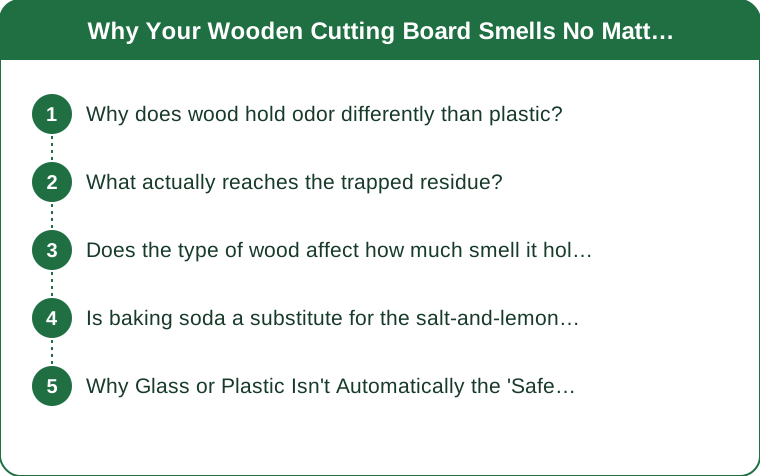
Why does wood hold odor differently than plastic?
Wood grain has microscopic pores that absorb liquid and small food particles below the visible surface, while a sponge and soap only clean what’s on top. Plastic boards, by contrast, are less porous but develop deep knife-groove bacteria colonies instead — different material, different trapping mechanism, same end result of lingering smell.
What actually reaches the trapped residue?
Coarse salt scrubbed into the surface with half a lemon acts as a mild abrasive and mild acid combination, working into the grain in a way a sponge can’t. Letting the salt and lemon sit for a few minutes before rinsing gives it time to draw residue out of the pores, not just off the surface.

Does the type of wood affect how much smell it holds?
Yes — denser woods like maple hold less odor than more porous woods like walnut or bamboo (technically a grass, but similarly porous), so board material is worth factoring in if odor has been a persistent issue across multiple boards.
Is baking soda a substitute for the salt-and-lemon method?
It helps with mild odor but works mainly on the surface rather than drawing residue from deeper in the grain, making it a reasonable maintenance step between deeper salt-and-lemon treatments rather than a replacement for them.
Why Glass or Plastic Isn’t Automatically the ‘Safer’ Swap
Switching away from wood to avoid the smell issue trades one set of tradeoffs for another — plastic boards develop deep knife grooves that can harbor bacteria more than a well-maintained wood board does, so the odor problem isn’t necessarily a safety problem in the first place.
TL;DR:
- Wood’s porous grain traps residue that surface washing can’t reach
- A coarse salt and lemon scrub, left to sit briefly, pulls residue from deeper in the grain
- Denser woods like maple hold less odor than more porous options
- Odor isn’t the same as a safety issue — plastic has its own bacterial tradeoffs
A monthly deep scrub, not more frequent light washing, is usually what actually solves it.
Keep Reading
This article is for general informational purposes only and is not medical advice. Always consult a qualified health professional for guidance specific to you.